When children make up their own stories, they practise skills that help with reading and writing later: putting events in order, explaining why something matters and choosing words. You don’t need to prepare anything, just listen and write. Here’s how to get started from around age three, what the research says and how a story can become a real book.
Why it’s worth fifteen minutes
In a US study, researchers followed 32 children from the ages of five to eight. The five-year-olds who explained why something mattered in their stories, rather than simply saying what happened, had better reading comprehension at eight. Those who had the strongest grasp of how a story fits together wrote better stories themselves three years later (Griffin et al., 2004).
A review of 40 studies found that helping children practise storytelling makes a difference. The most effective approaches had things in common: talking about how stories are put together, using pictures and words as prompts, and giving children plenty of chances to tell stories (Pico et al., 2021).
Storytelling isn’t just for school. Early-years educators value it too: Sweden’s preschool curriculum, for example, encourages children to play with words, tell stories, express their thoughts and create in different ways. At home, there’s no need for a plan. Someone to ask, listen and write things down is enough.
What children can do at different ages
Speech and language therapists often describe storytelling in stages. Around two to three, children list things that happen one after another. At three to four, the events connect, but there may not be much of a plot. At four to five, events become more ordered, and from around five to seven, stories begin to have a problem and a solution (NHS, based on Applebee).
These stages are a guide, not a timetable. What matters is meeting your child where they are: a three-year-old may need questions to keep the story moving, while a seven-year-old might enjoy help shaping a beginning, middle and end.
Ages 3–4: talk about what happened
Start with something your child knows. Ask them to tell you about their day at nursery, a story you’ve read together or a picture they’ve just drawn. Try asking and what happened next? rather than what was the most fun, and repeat their own words before asking another question.
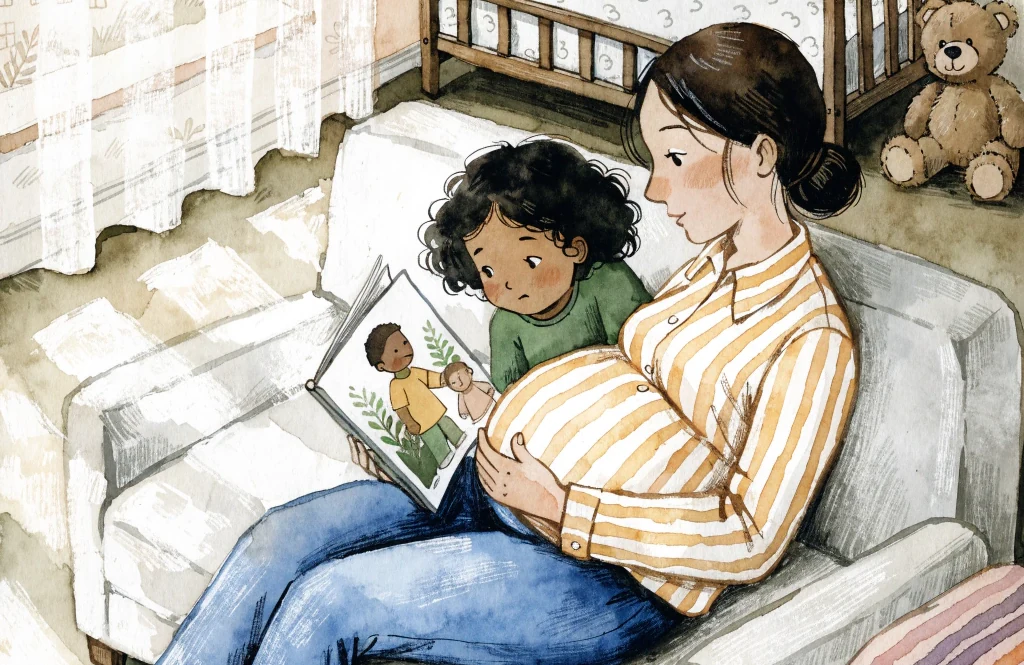
You can do the same when you read together. Pause and let your child tell you what’s happening in the picture, then swap roles so they’re the storyteller and you’re the one asking questions. This is called dialogic reading, and it has been shown to help children develop richer language (What Works Clearinghouse).
Researchers at the University of Gothenburg filmed three- to five-year-olds retelling stories. The children adapted their stories to their listeners, kept their structure and used voices and gestures. The ability is there early on, but children need space to use it and an adult who takes their storytelling seriously (University of Gothenburg).
Ages 5–6: your child tells, you write
Around the age of five, many children can make up a whole story but aren’t yet able to write it down themselves. That’s where you come in. Teacher and author Vivian Paley invited children to dictate their stories word for word while she wrote. Later that day, the children acted them out on a stage marked with tape on the floor, with each storyteller choosing their own role. Sweden’s National Agency for Education describes the method in its early-years teaching materials.
A few things make a big difference. Write down exactly what your child says, without correcting it. Read each sentence back before they carry on. Ask about anything that isn’t clear, such as who is speaking, but try not to suggest what should happen next. At the end, read the whole story aloud, perhaps to someone else too.
If you speak more than one language at home, write the story in the language your child tells it in. It’s their story, and it will come most easily in the language they feel most comfortable using.
Ages 7–9: beginning, middle and end
In the early school years, children learn how to shape a story with a beginning, a sequence of events and an ending, and how to describe a character. They also create texts that bring words and pictures together. These skills appear in curricula around the world, including Sweden’s primary-school Swedish curriculum.
At home, turn it into a game. Draw the hero first and decide what they’re called, what they’re good at and what they’re afraid of. That fear can become the story’s problem. Let the hero try to solve it three times: two attempts that fail and one that succeeds. It’s an old storytelling trick, and it gives the story a middle. Our story template follows just this pattern.
Tools to get a story started
The first sentence is often the hardest. Dice with words or pictures give you a starting point that nobody has to invent: who, where and what happens. You can print and cut out our story dice, or roll them on the page.
Many children find it easier to tell a story if they draw first. A drawing gives them something to point to, and the hero has a face before they have a story. If your child would like some help getting started, there are simple characters to draw step by step.
Story stones, small stones each marked with a picture, work in much the same way: your child picks one at a time and carries on telling the story. These tools haven’t each been studied on their own, but they offer things the reviews point to: pictures to hold on to and a clear sequence.
What it might sound like
Here’s how a story might begin when a five-year-old and an adult roll the story dice: a robot on the moon finds a secret map.
‘What’s the robot called?’
‘Blinka. She blinks when she thinks.’
‘And what’s on the map?’
‘A cross. By a crater.’
‘What do you think is there?’
‘An ice cream that never melts, because it’s so cold on the moon.’
‘What happens when Blinka goes there?’
The adult hasn’t made anything up. She has asked questions, repeated the child’s words and written them down. The story belongs to the child, and it already has a hero, a setting, a goal and room for something to go wrong.
When the story is finished
Read it aloud that evening, and again the next day. Children who have made up a story often want to hear it several times, adding new details each time. Act it out, let Grandma hear it over the phone or put the drawing on the fridge.
If you’d like to keep it, you can turn it into a book. Research into personalised books suggests that children learn new words better in parts of a book that are about themselves, and that they talk more about such books (Kucirkova et al., 2014). The same researcher reminds us that a book about a child should open up new ideas, not just reflect what they already know (The Psychologist, 2015). A story your child has made up can do both: it’s their own, and it takes them somewhere they’ve never been before.
If you’d rather read a ready-made story tonight, you’ll find children’s stories to read aloud on our site. You can also read more about why reading aloud matters.
Would you like to see a finished book before you decide? Browse our example books.
The next story could be about your child
Upload a photo or a drawing your child has made, and we’ll create an illustrated story with them as the hero.
- 1
A photo or a drawing
Your child becomes the hero, or the character they’ve drawn does. Brothers, sisters, Grandma and the cat can join in too.
- 2
Choose what the story is about
Pick a theme, a message and things your child loves. You can add details you’ve made up together too.
- 3
Read it tonight
The eBook is ready in minutes and costs €6.99. You can add a hardback for €36.99 more.